
Entry in When and How Your Insurer Finds Out About a Ticket
How Often Do Car Insurance Companies Check Driving Records?
Discover how and when auto insurers review your motor vehicle record, what triggers an unscheduled MVR check, and what happens after a speeding ticket.

By Brandon Lee · Editor
Published
Answer in brief
Auto insurers do not continuously monitor your driving record; instead, they typically pull an updated motor vehicle record at policy renewal or when major coverage adjustments occur. Because ordering records costs money, some carriers pull records only once annually or audit select policyholders, meaning a speeding ticket may not affect your premium until your next formal renewal.
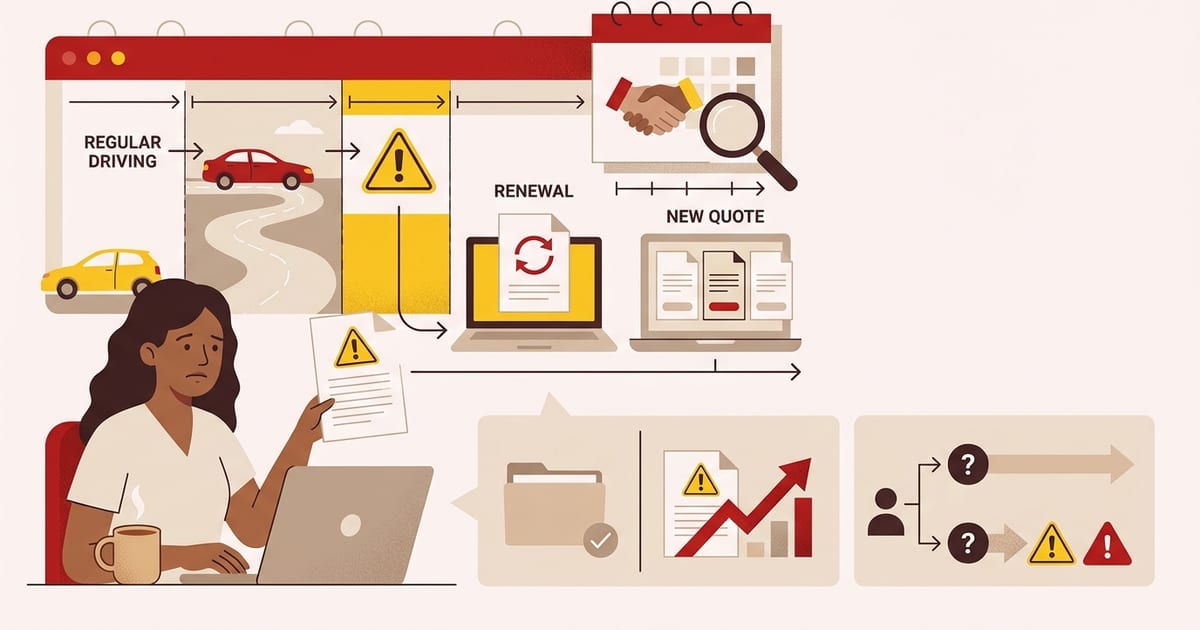
A common misconception among drivers is that receiving a traffic ticket results in an immediate, same-day premium increase. In reality, car insurance companies do not maintain real-time tracking feeds on policyholder licenses. Underwriters only discover moving violations when they pull an official motor vehicle record (MVR) from your state licensing agency. Knowing when and how often insurers review these records helps you understand when a rate change might occur, giving you adequate time to manage your driving profile or shop for alternative coverage.
The Routine Schedule for Driving Record Reviews
Insurance carriers operate on standard six-month or twelve-month policy terms. Each time an insurer pulls an MVR from a state licensing agency, the carrier must pay an administrative fee charged by the state. Because pulling driving histories across hundreds of thousands of policyholders generates significant operational overhead, insurers balance financial expense against underwriting risk. While some carriers pull driving records at every six-month renewal, others order full reports only once a year, or utilize automated notification programs that scan for severe infractions while skipping full audits on clean accounts.
| Policy Event | MVR Pull Likelihood | Underwriting Impact |
|---|---|---|
| Standard Policy Renewal | Every 6 to 12 months | Carrier reviews driving history; surcharges are applied starting on the renewal effective date. |
| Adding a Vehicle or Driver | Immediate / Upon request | A full risk reassessment is initiated for all household operators listed on the policy. |
| Reinstating a Lapsed Policy | Immediate upon reactivation | Underwriters verify overall risk eligibility before issuing active financial responsibility certification. |
| State Boundary Relocation | Upon policy transfer | Driving record is checked against the new state licensing database and updated state statutory limits. |
Triggers That Prompt an Unscheduled Record Audit
Outside of regular renewal cycles, specific account activities prompt underwriters to order an unscheduled MVR. Adding a newly licensed household member—particularly a driver under age 25, who carries a statistically elevated fatal crash rate according to Insurance Information Institute data—almost universally triggers a fresh record pull. Moving to a new state also requires re-evaluating risk under local mandatory liability statutes. For example, moving to California requires updating coverage to meet statutory minimum liability limits of $30,000 per person, $60,000 per accident bodily injury, and $15,000 property damage under Cal. Veh. Code § 16056. Similarly, relocating to Virginia requires meeting statutory minimum limits of $50,000 per person, $100,000 per accident bodily injury, and $25,000 property damage under Va. Code § 46.2-472. When an agent updates your policy for new state compliance, an MVR pull frequently follows.
What Happens When an Insurer Identifies a Citation
When an MVR audit reveals an active moving violation, the underwriter matches the conviction code against the company's rating manual. In most jurisdictions, an insurer cannot raise your rates mid-term for a moving violation that occurred after the policy effective date; any new surcharge takes effect when your policy formally renews. If the MVR reveals severe or multiple tickets, the carrier may issue a nonrenewal notice. Drivers who find themselves dropped by standard carriers must transition to a non-standard insurer or seek coverage through their state's assigned-risk residual insurance plan, as outlined by the Insurance Information Institute.
Strategic Steps Before Your Next MVR Audit
- Verify the Official Conviction Date: Surcharges are calculated from your formal conviction date—the day a court enters judgment or you pay the fine—rather than the day the ticket was written.
- Utilize State-Approved Traffic School: If permitted by your jurisdiction, complete court-approved traffic school for conviction masking to prevent the citation from surfacing on public insurance MVR extracts.
- Audit Your Own Driving Record: Order an official copy of your driving abstract directly from your state licensing agency to confirm that resolved tickets or dismissed citations do not appear incorrectly.
- Adjust Optional Coverages: Before your renewal executes, evaluate physical damage deductibles. Raising collision and comprehensive deductibles from $200 to $500 or $1,000 can cut physical damage costs between 15% and 40%+, according to the Insurance Information Institute.
- Shop Competitor Rates Proactively: Because different insurers pull records at varying intervals and weigh infractions under separate guidelines, gathering multiple quotes before your renewal date allows you to lock in competitive pricing.
Questions & answers
Does my car insurance company find out about a speeding ticket right away?
No. Insurers do not receive instantaneous notices when a citation is issued. Carriers typically discover moving violations only when they pull an updated motor vehicle record (MVR) from your state licensing agency at policy renewal or during a major coverage modification.
Can an insurance company increase my rates in the middle of a policy term after a ticket?
In almost all states, insurers cannot alter your premium mid-term due to a newly acquired minor speeding ticket. Your agreed-upon rate remains locked until the end of your six-month or twelve-month term, at which point the surcharge is applied to your renewal offer.
Do insurance companies check all drivers on a policy at every renewal?
Not necessarily. Because state licensing agencies charge fees for every MVR generated, some insurers review records annually rather than every six months, or use automated risk-monitoring tools that audit only policyholders who trigger specific risk flags.
What happens if an insurer decides not to renew my policy after reviewing my driving record?
If multiple violations push you beyond an insurer's underwriting guidelines, the company will issue a formal nonrenewal notice prior to policy expiration. Drivers in this situation can shop with non-standard insurers or secure required financial responsibility through their state's assigned-risk insurance plan.
Terms: Motor vehicle record (MVR), Conviction date, Surcharge, Non-renewal, Material misrepresentation
Sources and references
Legal figures on this page (minimum limits, filing periods, statutory benefits) are checked against the primary law or the state insurance regulator listed below. Links and figures last verified Nov 2026.
- Vehicle Code § 16056 — minimum liability limits — California Legislative Information, Cal. Veh. Code § 16056Primary lawPolicies issued or renewed on/after 1 Jan 2025: $30,000 per person / $60,000 per accident bodily injury / $15,000 property damage. From 1 Jan 2035 the limits rise by $20,000 / $40,000 / $10,000 (to 50/100/25).
- Va. Code § 46.2-472 — minimum liability limits — Virginia Law (LIS), Va. Code § 46.2-472Primary lawFor policies effective on/after 1 Jan 2025: $50,000 per person / $100,000 per accident bodily injury / $25,000 property damage.
- Speed — Insurance Institute for Highway SafetyIndependent researchHow speed raises crash likelihood and severity; speed-limit and enforcement research.
- What if I can't find auto coverage? — Insurance Information InstituteConsumer guidanceHow the non-standard market and state assigned-risk plans insure drivers the voluntary market declines.
- What determines the price of an auto insurance policy? — Insurance Information InstituteConsumer guidanceRating factors: driving record, mileage, location, age, gender, vehicle, credit-based insurance score, coverage choices. Notes ZIP-code rating is prohibited in California and Michigan and gender rating is prohibited in seven states.
- Nine ways to lower your auto insurance costs — Insurance Information InstituteConsumer guidanceShop at least three quotes; raising a deductible from $200 to $500 can cut collision/comprehensive cost 15–30%, $1,000 can save 40%+; drop physical damage on cars worth under 10× the premium; bundling, low-mileage and good-student discounts.
- Consumer insurance information — National Association of Insurance CommissionersConsumer guidancePlain-language guides from the body of state insurance regulators; links to every state's insurance department and complaint process.
- Car insurance — Consumer ReportsConsumer guidanceIndependent testing organisation's guides to comparing policies and insurers.
Practical guidance on this page is original editorial work. Cited sources support factual statements and do not endorse this site. Dollar ranges described as typical or illustrative are editorial estimates, not figures from these sources.